
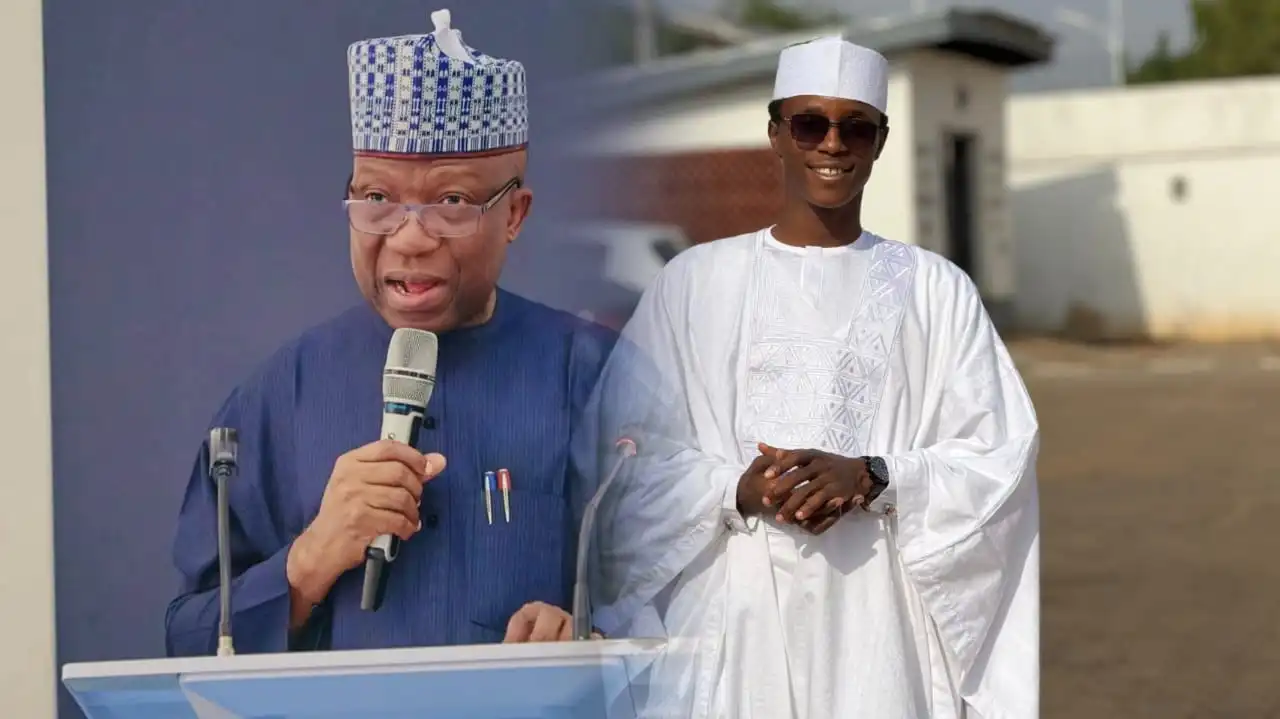
A fresh political controversy has erupted in Kwara State following a scathing critique of Abubakar Sulaiman, Director General of the National Institute for Legislative and Democratic Studies (NILDS), over his alleged comments on the 2027 governorship race.
In a strongly worded statement, Saddiq Buhari accused the professor of attempting to undermine the political relevance and electoral strength of Kwara North, particularly amid growing agitation for power rotation to the district.
Buhari faulted what he described as Prof. Sulaiman’s “intellectually dishonest” position that a governorship candidate from Kwara North may not secure victory in the state. He argued that such claims lack empirical backing and fall short of expectations from an academic of Sulaiman’s stature.
Read the full article here:
Revisiting the Political Reality of Kwara North: A Note to Professor Abubakar Suleiman
By Saddiq Buhari
Recently, Professor Abubakar Olarewaju Suleiman, Director General of the National Institute for Democratic Studies (NILDS), has audaciously attempted to undermine the political legitimacy and acceptability of Kwara North within the state’s electoral landscape. This time, it is no longer veiled; he had to personally express his frustration at the uncontrollable level of popularity of the power shift to Kwara North come 2027.
The intellectually dishonest submissions of Prof. Suleiman, where he tacitly asserted that a gubernatorial candidate from Kwara North cannot win an election in Kwara State, and insinuating that only a candidate from Kwara Central Senatorial District could win a gubernatorial election—are not only disappointing but also a betrayal of his acclaimed academic standing.
Such a submission, lacking empirical basis, is the least expected from a professor. It gives impetus to the alleged questionability of Professor Suleiman’s academic pedigree, as it betrays his years of supposed research acumen. He deliberately restricted his warped analysis to the 2023 elections, when in fact, he was a major actor in the 2015 and 2019 elections in Kwara State—periods when APC has dominated Kwara North, among other senatorial districts in Kwara state. He chooses to look away from these facts because they invalidate his selfish political hypotheses.
If Prof. Suleiman suffers from selective amnesia, I would like to remind him that in the 2011 Kwara State gubernatorial election, a candidate from Kwara Central was roundly defeated—even in Kwara Central local governments by a Kwara Southerner, who emerged as the successor to His Excellency, Dr. Bukola Saraki.
In 2015, Kwara Southerners were fielded by the two major political parties. Prof. Suleiman was then a sitting Minister of the Federal Republic of Nigeria, but he couldn’t demonstrate political capacity, and his party lost again. He was later questioned about campaign funds, and the rest, as they say, is history.
Fast forward to 2019, Prof. Suleiman was a stalwart of the People’s Democratic Party (PDP), which fielded a Kwara Central candidate as an incumbent, with a sitting governor from Kwara South and incumbent Senate President Bukola Saraki. Despite these factors, the party was decisively defeated, reflecting a clear rejection by the people and not a regional power play.
In 2023, the PDP’s decision to zone the gubernatorial ticket to Kwara North was perceived by the people of Kwara North as a mere ploy to use the senatorial district in a futile political battle against a sitting governor enjoying widespread goodwill and seeking re-election.
Our people knew that the ideal time to cede the ticket to Kwara North was at the end of an outgoing government’s two-term tenure, as it was in 2015 for Kwara South. However, we were continually betrayed until they saw the need to use Kwara North as pawns in 2023, which we rejected outrightly. The PDP’s defeat that year was not a loss for Kwara North but a reaffirmation of Kwarans’ collective stance in the 2019 general elections against the ousted political actors in the state.
Prof. Suleiman, as the Director General of the PDP gubernatorial campaign in 2023, not only lost his polling unit to the APC but also lost his local government and the entire Kwara Central Senatorial District. It is noteworthy that the leader of the PDP is from same ward and local government as Prof. Suleiman. The same applies to Kwara South and Kwara North they lost everywhere, not just in Kwara North.
What happened in 2023 was a rejection of inconsistent characters like Prof. Suleiman and his political party and had nothing to do with regional bias against Kwara North, either by Kwara Northerners or other senatorial districts. It is, therefore, amusing how a man with no proven political acceptability attempts to position himself as superior to and ahead of array of Kwara Northerners, whom have demonstrated political acceptability and popularity in previous elections. Indeed, Prof. Suleiman failed to meet all criterion of historical voting trends, grassroots networks, and popularity which he noted as essential for candidate selection.
For empirical emphasis, people like Prof. Suleiman should be cautioned not to mistake the consistent APC dominance in Kwara North as a sign of political weakness. On the contrary, it should be seen as a source of strength. Drawing inference from the 2023 elections he referenced, electoral records show that despite Gov. AbdulRahman AbdulRazaq seeking a second term and being of Kwara Central extraction, he performed better electorally in Kwara North than even in Kwara Central. This nullifies Suleiman’s and his likes’ assumption that the 2023 loss by the PDP was solely due to regional bias.
For instance, in the four local governments within Kwara Central—Asa, Ilorin East, Ilorin South, and Ilorin West—Gov. AbdulRazaq secured 53.56%, 56.74%, 56.05%, and 55.48% of votes, respectively. None of these local governments delivered up to 60% of their total votes for the APC gubernatorial candidate. In contrast, in Kwara North, the governor scored over 60% in all five local governments, except Edu, where the PDP gubernatorial candidate hails from, and the governor secured 54.4% of votes.
In Baruten, Gov. AbdulRazaq obtained 74.09% of votes; in Kaiama, 66.28%; in Moro, 61.97%; and in Pategi, 65.85%. These figures outperform all local governments in Kwara Central, demonstrating that claims of regional bias in voting pattern are baseless and spurious, propagated by disillusioned academia.
Electoral statistics further reveal that, despite the overall dominance of APC in Kwara State, the party experienced reduced winning margins in Kwara Central local governments. Meanwhile, APC maintained strong dominance in Kwara North, with only minor erosion in Edu, largely due to the influence of Shuaib Yahman.
For the umpteenth time, I appeal to Prof. Suleiman to focus his campaign on presenting what he has to offer Kwarans, rather than displaying frustration over the popularity and acceptability of the 2027 power shift to Kwara North. Perhaps, if not now, he may still need the good people of Kwara North in future elections.
Lastly, I wish to correct him: Kwara North is not begging for his empathy, as he insultingly suggested. We are not in a sympathetic situation. We only seek a fair chance to participate in the leadership of a state that belongs collectively to all of us.